News
02.04.2026
SPINE Seminar at University of Gdańsk: How to Assess Public Transport Priority Measures
A data-driven discussion on bus lanes, travel time, reliability and impact evaluation
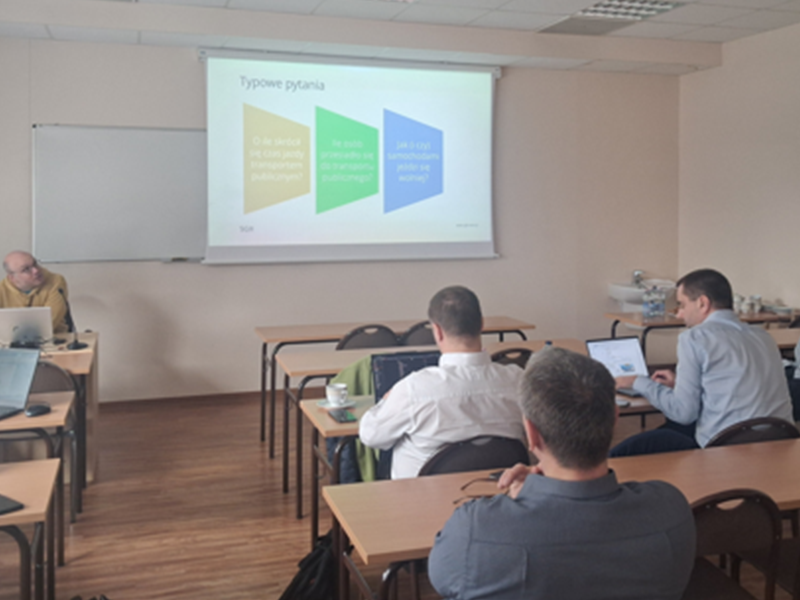
On 2 April 2026, the Faculty of Economics, University of Gdańsk hosted a SPINE EU project seminar dedicated to methods for assessing the effects of public transport priority measures. The discussion brought together researchers, transport practitioners and public transport operators and focused on a shared question: how can cities measure whether bus lanes and signal priority really improve PT in urban mobility?
A key message from the SPINE presentation was that bus lanes should be understood as part of a wider corridor strategy rather than an isolated street segments. In Gdynia (Poland), the ongoing work aims to build a coherent framework for public transport bus corridors by 2030, supported by complementary measures such as traffic signal optimisation. The seminar highlighted that the real value of a bus lane lies not only in the length of a single section but also in the continuity and complexity of the whole corridor and its ability to reduce travel times along meaningful journey chains.
The debate also stressed that the selection of new bus lane sections should rely on data rather than intuition. Suggested criteria included current and forecast passenger demand, the number of residents along a corridor, vehicle occupancy, service frequency, stop patterns, investment costs and external disruptions such as roadworks or congestion. This approach is already supported by close cooperation between the University of Gdańsk, Public Transport Authority in Gdynia (ZKM Gdynia) and the Gdynia’s SPINE project team and also includes the analysis of vehicle delays, helping to identify bottlenecks in the transport network.
Another important part of the seminar concerned how to evaluate the effects of priority measures. Participants agreed that average travel time alone is not enough. More useful indicators include the distribution of travel times, the share of delayed trips, the number of passengers benefiting from faster services and the change in reliability. The discussion showed that even a small improvement in average time can have a substantial impact if it affects the most crowded services during peak hours. Modern ITS data, on-board systems and passenger counting systems inside vehicles will play a central role in this assessment.
The seminar also addressed the role of transport models and the wider policy context. Macroscopic, mesoscopic and microscopic models were presented as complementary tools for selecting promising corridors and testing scenarios. At the same time, the funding perspective was discussed: bus lanes are not an end in themselves, but they form element of a broader package aimed at reducing emissions, improving accessibility and making public transport more attractive than private cars. The seminar concluded that the success of public transport priority should be measured through a combination of time savings, reliability, passenger shift, operational efficiency and environmental benefits.